
Stroke Symptoms: 7 Warning Signs You Should Never Ignore
A stroke can happen suddenly, and the first few minutes can be critical.
Recognizing the warning signs of a brain stroke and seeking emergency medical attention quickly can make an important difference in treatment and recovery. Stroke occurs when blood flow to part of the brain is blocked or when a blood vessel in the brain ruptures, causing brain tissue to become damaged.
Knowing the symptoms can help you recognize a stroke in yourself or someone around you.
What is a stroke?
A stroke, sometimes called a “brain attack,” occurs when the brain does not receive adequate blood supply.
There are two major types:
1. Ischemic stroke
An ischemic stroke occurs when a blood clot or other material blocks an artery supplying the brain.
2. Hemorrhagic stroke
A hemorrhagic stroke occurs when a blood vessel in the brain ruptures and causes bleeding.
Both types of stroke are medical emergencies and require urgent evaluation and treatment.
7 Warning Signs of Stroke
Stroke symptoms usually appear suddenly. They may affect one side of the body, speech, vision, balance, or consciousness.
1. Sudden weakness or numbness
Sudden weakness or numbness of the face, arm, or leg, particularly on one side of the body, is a common warning sign.
For example, a person may suddenly find that one arm feels weak or that they cannot raise both arms equally.
2. Facial drooping
Ask the person to smile.
Does one side of the face appear to droop? Is the smile uneven?
Sudden facial weakness can be a sign of stroke.
3. Difficulty speaking or understanding
A person experiencing a stroke may suddenly:
- Slur their speech
- Have difficulty finding words
- Be unable to speak clearly
- Say inappropriate or confusing words
- Have difficulty understanding what others are saying
Sudden speech or language difficulty should never be ignored.
4. Sudden vision problems
Stroke can cause sudden visual symptoms, including:
- Blurred vision
- Double vision
- Loss of vision in one or both eyes
- Difficulty seeing to one side
Sudden visual changes require urgent medical assessment.
5. Sudden dizziness or loss of balance
A person may suddenly develop:
- Severe dizziness
- Difficulty walking
- Loss of balance
- Poor coordination
These symptoms can sometimes be mistaken for an inner-ear problem. When they occur suddenly—particularly together with other neurological symptoms—stroke needs to be considered.
6. Sudden severe headache
A sudden, severe headache without an obvious cause can be a warning sign of stroke, particularly certain types of bleeding in or around the brain.
A sudden severe headache accompanied by vomiting, loss of consciousness, weakness, confusion, seizures, or neurological symptoms requires emergency assessment.
7. Sudden confusion or altered consciousness
Sudden confusion, difficulty understanding others, unusual behaviour, reduced responsiveness, or loss of consciousness can occur with a stroke.
These symptoms require urgent medical evaluation.
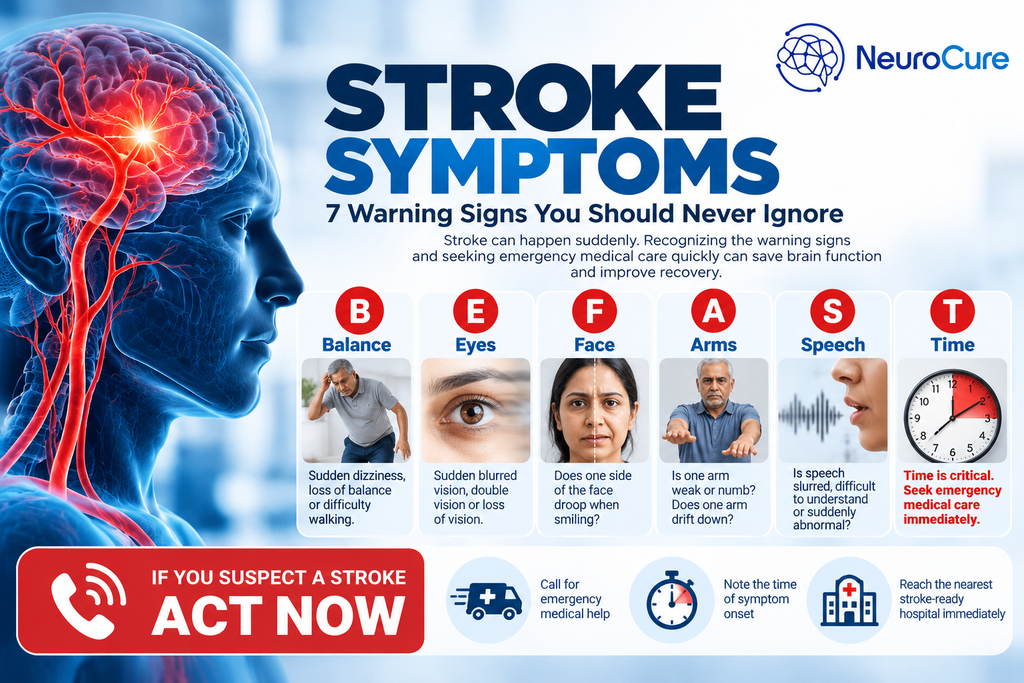
Remember B.E. F.A.S.T.
One of the easiest ways to remember important stroke warning signs is B.E. F.A.S.T.
B — Balance
Is there sudden dizziness, loss of balance, or difficulty walking?
E — Eyes
Is there sudden blurred, double, or lost vision?
F — Face
Does one side of the face droop when the person smiles?
A — Arms
Is one arm suddenly weak or numb? Does one arm drift downward when both arms are raised?
S — Speech
Is speech slurred, difficult to understand, or suddenly abnormal?
T — Time
Time is critical. Seek emergency medical care immediately.
The American Stroke Association and CDC recommend using B.E. F.A.S.T. to recognize stroke warning signs and emphasize rapid action.
What Should You Do If You Suspect a Stroke?
If you notice sudden stroke symptoms in yourself or another person:
1. Treat it as an emergency
Do not wait to see whether the symptoms improve.
2. Note the time
Remember or record when the symptoms started or the last time the person was known to be well.
This information can be extremely important when doctors determine which treatments may be appropriate.
3. Get emergency medical help
Arrange immediate transport to an appropriate emergency medical facility capable of evaluating and treating acute stroke.
4. Do not delay treatment because the symptoms seem mild
Even symptoms that appear minor can represent a serious stroke or transient ischemic attack.
5. Do not ignore symptoms that disappear
If neurological symptoms disappear after a few minutes, the person may have experienced a transient ischemic attack (TIA).
A TIA is a warning sign and still requires urgent medical evaluation. At the beginning, it may not be possible to distinguish a TIA from a completed stroke without medical assessment.
Why Is Time So Important in Stroke?
The brain depends on a continuous supply of oxygen and nutrients through its blood vessels.
When blood flow is interrupted, brain tissue can become damaged.
That is why rapid stroke recognition, diagnosis, and treatment are essential. Some patients with ischemic stroke may be candidates for clot-dissolving treatment, while selected patients with large-vessel blockage may benefit from mechanical thrombectomy, a procedure used to remove the clot and restore blood flow. Eligibility depends on factors such as the type of stroke, imaging findings, time from symptom onset, and the patient’s individual circumstances.
The exact treatment cannot be determined from symptoms alone. Urgent brain imaging and specialist assessment are necessary.
How Is a Stroke Diagnosed?
When a patient reaches the hospital with suspected stroke, the medical team will rapidly assess:
- Neurological symptoms
- Time of symptom onset
- Blood pressure and other vital signs
- Blood glucose and relevant laboratory parameters
- Previous medical conditions and medications
- Brain imaging
CT or MRI of the brain may be required to determine the type and location of the stroke and guide treatment.
Additional vascular imaging may be required in selected patients.
How Is Stroke Treated?
Treatment depends on the type of stroke.
Treatment of ischemic stroke
For eligible patients, treatment may include medicines that dissolve blood clots and, in selected cases, mechanical thrombectomy to remove a clot from a blocked major blood vessel.
Treatment eligibility depends on the individual patient and the findings on clinical assessment and imaging.
Treatment of hemorrhagic stroke
A hemorrhagic stroke requires management of the bleeding and its effects on the brain.
Depending on the location, size, cause, neurological condition, and other factors, treatment may include intensive medical management, management of intracranial pressure, treatment of the underlying blood-vessel abnormality, or surgery in selected patients.
This is one reason why rapid specialist evaluation is so important.
Can Stroke Be Prevented?
Many stroke risk factors can be identified and managed.
Important measures include:
- Controlling high blood pressure
- Managing diabetes
- Maintaining healthy cholesterol levels
- Avoiding smoking
- Maintaining a healthy weight
- Staying physically active
- Following a healthy diet
- Taking prescribed medications regularly
- Managing conditions such as atrial fibrillation when diagnosed
The American Stroke Association identifies blood-pressure control, not smoking, physical activity, healthy diet, healthy weight, and management of medical risk factors among important measures for reducing stroke risk.
What About a “Mini-Stroke” or TIA?
A transient ischemic attack (TIA) causes stroke-like neurological symptoms that resolve.
Because the symptoms may disappear, people sometimes assume that the problem has gone away.
That can be dangerous.
A TIA can be a warning that a person is at increased risk of a future stroke. It requires prompt medical evaluation to identify the underlying cause and reduce the risk of another event.
When Should You Seek Emergency Care?
Seek immediate emergency medical attention if someone suddenly develops:
- Facial drooping
- Weakness or numbness of an arm or leg
- Difficulty speaking or understanding
- Sudden visual disturbance
- Sudden loss of balance or coordination
- Sudden severe headache
- Confusion or reduced consciousness
- A seizure associated with new neurological symptoms
Do not wait for the symptoms to disappear.
The Most Important Thing to Remember
You don’t need to diagnose a stroke yourself.https://www.justdial.com/Pune/Dr-Abhijit-Chandankhede-Near-Loni-Station-Loni-Kalbhor/020PXX20-XX20-260619130503-J5N7_BZDET
You simply need to recognize the warning signs and act quickly.
B.E. F.A.S.T.
Balance → Eyes → Face → Arms → Speech → Time
If these symptoms appear suddenly, treat them as an emergency and seek immediate medical care.
Expert Neurosurgical & Brain Care at NeuroCure
At NeuroCure, we provide specialist evaluation and https://neurocure.in/services/management of a range of neurological and neurosurgical conditions.
If you or a family member has experienced symptoms suggestive of stroke or TIA, timely medical evaluation is important to identify the cause, assess future risk, and determine appropriate treatment.
Dr. Abhijit Chandankhede
Consultant Neurosurgeon & Spine Surgeon
NeuroCure
For emergencies: Do not wait for an online consultation or chatbot response. Seek immediate emergency medical care.
Disclaimer: This article is intended for general educational purposes and does not replace medical consultation, diagnosis, or emergency treatment. Stroke symptoms require urgent medical evaluation.